02Substrate Thermal Dynamics & Depth Penetration
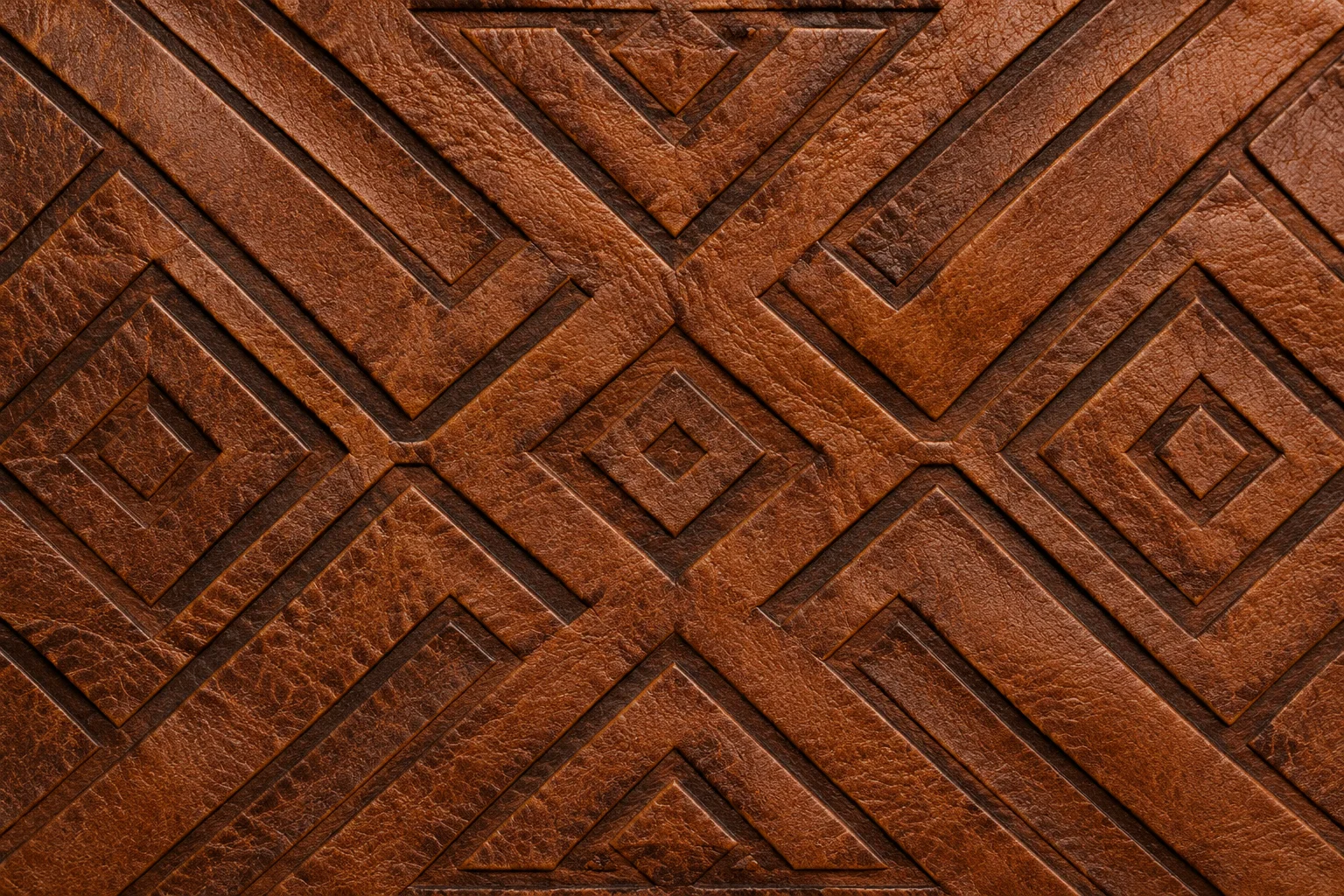
Vegetable-tanned leather reacts to 10.6 µm infrared radiation through progressive dehydration, organic pyrolysis, and structural carbonization. In this bench trial, 3.2 mm full-grain cowhide swatches were subjected to a calibrated speed-versus-power matrix to pinpoint the transition zone between superficial surface scorching and dimensional debossing. At settings below 12% peak power at 400 mm/s, the focused beam merely scuffs the epidermis, resulting in pale, uneven contrast. Once the beam breaches the dense grain layer and engages the underlying corium fibers, material ablation stabilizes, delivering predictable trench depths from 0.25 mm to 0.70 mm.
Excessive dwell times or power ratings above 28% rapidly denature the natural collagen matrix. Rather than producing clean cavity bottoms, excessive radiant energy carbonizes the surrounding fibrous walls, leading to brittle margins and chalky soot that rubs off during mechanical flexure. Maintaining an engraving line interval between 0.065 mm and 0.080 mm with bidirectional hatching ensured uniform bottom topography without corrugated banding or uneven thermal sag across the test grid.
“Controlling laser relief on organic cowhide requires balancing energy delivery with moisture equilibrium; depth achieved through pure heat produces ash, while depth achieved through speed preserves the integrity of the corium.”
— Sarah Jenkins, Materials Testing Specialist
03Carbonization Control & Environmental Observations
Consistent relief depth in natural hide cannot be decoupled from environmental conditioning and active debris evacuation. Laboratory readings demonstrated that moisture content within the leather directly dictates focal absorption and edge soot distribution during active passes:
- Hydration Sensitivity: Hides stabilized at 45% relative humidity exhibited 14% deeper clean ablation per watt compared to desiccated samples, which charred prematurely under identical beam power.
- Air Jet Geometry: High-pressure focused airflow swept away vaporized lipids before redeposition, eliminating sticky haloing along delicate vector perimeters.
- Post-Process Cleansing: Light brushing with an anhydrous isopropyl alcohol wipe cleared superficial carbon without leaching the vegetable oils or softening engraved edges.
04Operational Recommendations & Workflow Synthesis
For industrial embossing and architectural leather panels requiring crisp tactile relief, multi-pass processing at lower power outperforms single high-intensity passes. Executing two rapid passes at 14% power and 420 mm/s achieved a clean 0.50 mm cavity with negligible side-wall charring, maintaining pliable flex strength across the whole substrate. Operators should pre-condition raw hides in consistent humidity before running critical production runs and record batch-specific grain densities in their material ledgers.