02Controlling Oxidation Without Surface Ablation
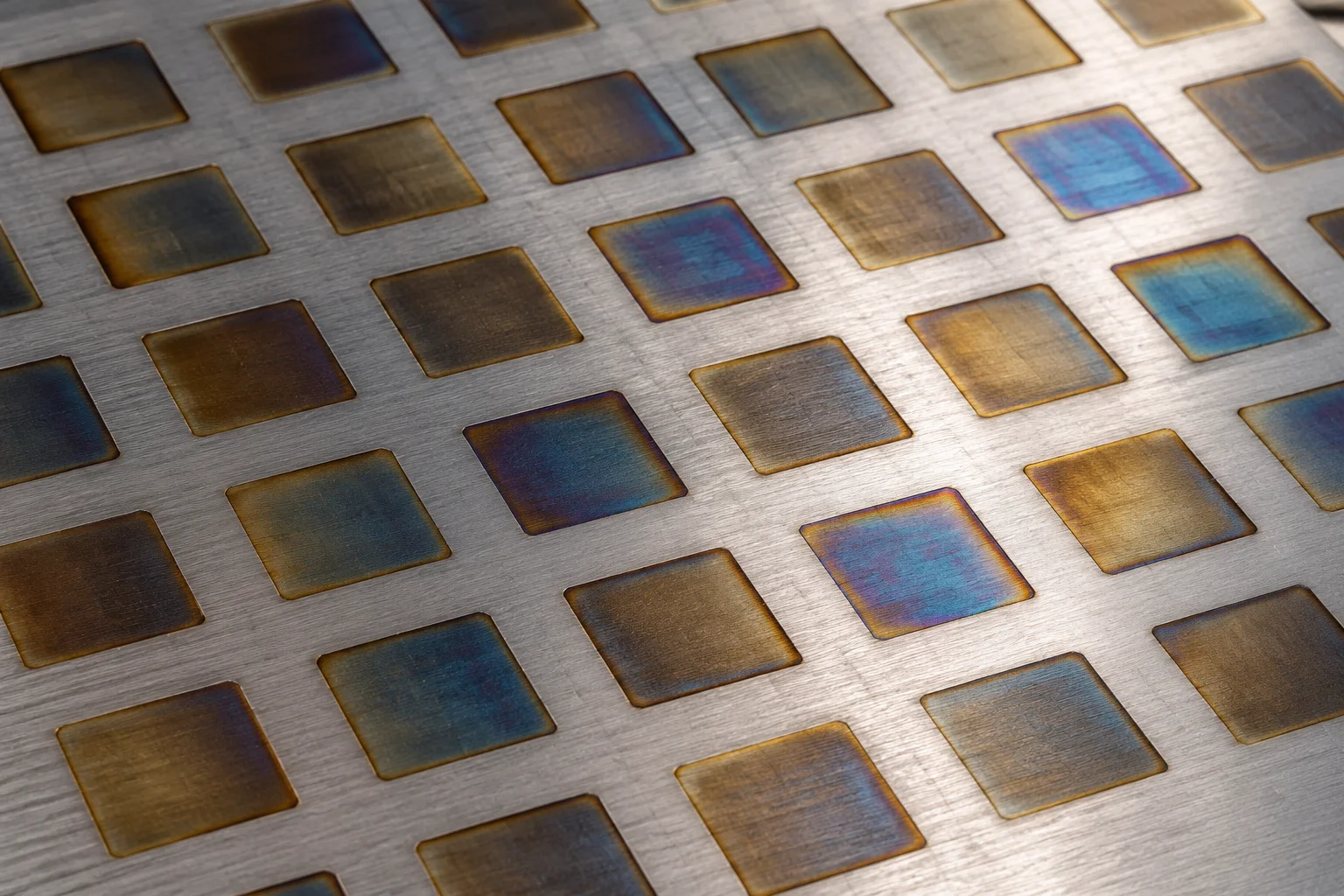
Laser annealing on stainless steel relies on sub-melting thermal induction under atmospheric oxygen. Rather than removing metal like conventional engraving, the laser elevates surface temperatures to approximately 700°C to 850°C. This promotes rapid growth of an optical interference layer of chromium oxide. The resulting hue shifts depending on layer thickness, transitioning through straw yellow, bronze, violet, and deep slate black.
Excess energy density disrupts this delicate mechanism. If peak irradiance triggers vaporization, the chromium-rich passivation layer breaks down, leading to surface pitting and subsequent corrosion vulnerability. During trials with cold-rolled 304 plate, tight scan spacing of 0.02 mm combined with gentle heat conduction maintained continuous oxide film coverage without warping 1.2 mm gauge sheets.
“Annealing is a delicate thermodynamic balance. If your focal spot produces an audible click or throws incandescent spatter, you have crossed from controlled oxide growth into destructive ablation.”
— James Miller, Principal Laser Applications Specialist
03Key Parameters Observed Across Trial Runs
Over forty-two individual sample runs on 304 alloy blanks, thermal energy distribution emerged as the defining factor for high-contrast legible markings:
- Frequency regulation: Operating at 30 kHz to 45 kHz produced stable thermal accumulation, whereas pulse rates above 65 kHz dispersed energy too quickly to reach consistent oxidation levels.
- Focal offset advantage: Shifting focus +2.0 mm expanded the active beam footprint to 80 µm, softening peak center intensity and preventing micro-grooving.
- Gas dynamics: Atmospheric oxygen provided the ideal stoichiometric balance; forced assist air caused erratic quench lines and color banding across the raster stroke.
04Industrial Applicability and Practical Summary
For medical instruments, food processing hardware, and aerospace traceability tags, laser annealing remains the gold standard. Because the surface topography remains smooth and unbroken, the markings do not collect residues or degrade during repeated sterilization cycles. Although annealing cycles require noticeably longer run times than aggressive vapor etching, the preservation of structural integrity makes it indispensable for quality-critical fabrication.