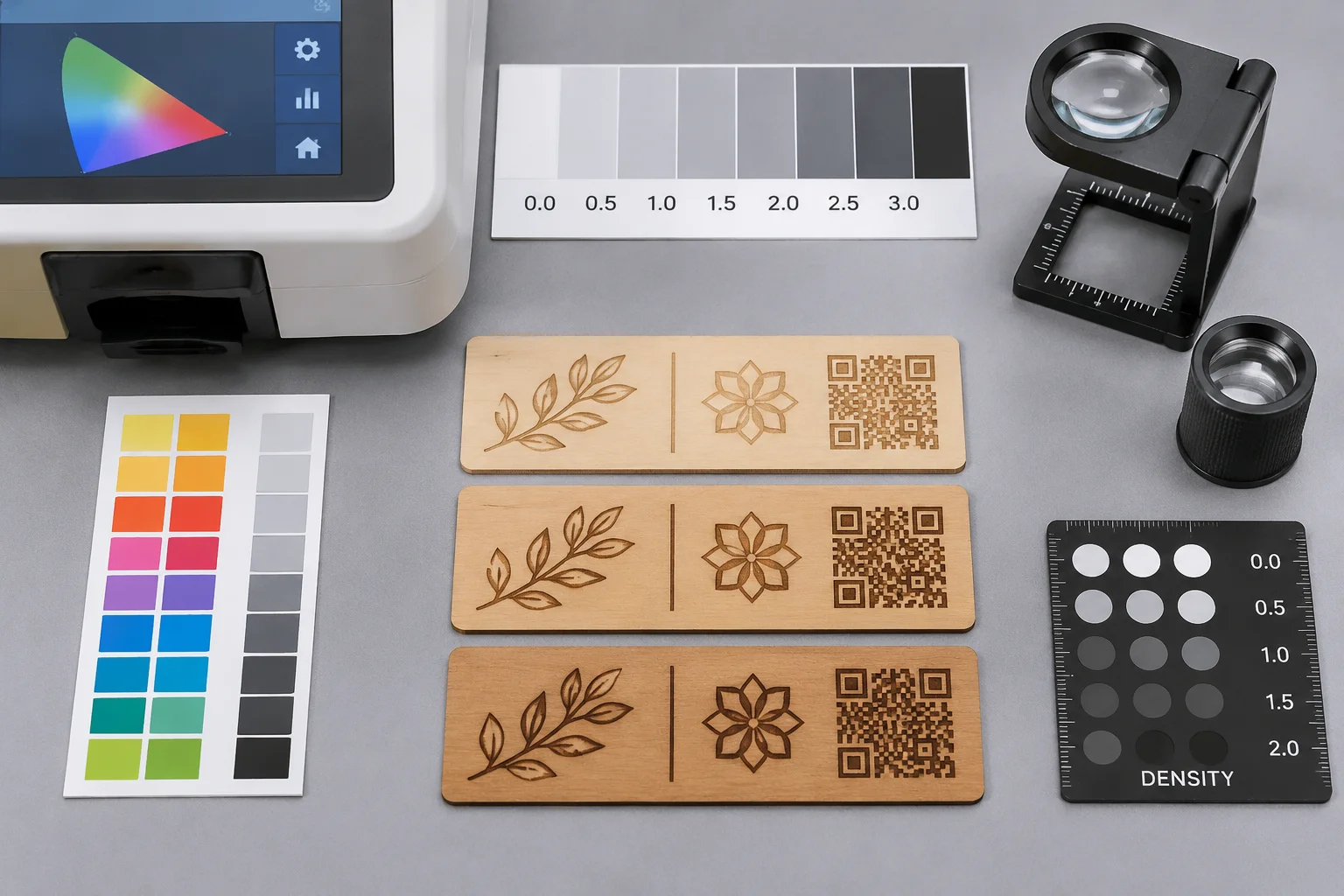
The Dilemma of Subjective Contrast Assessment
Material testing records frequently summarize engraving quality using vague descriptors such as rich dark, medium brown, or crisp white. These qualitative labels conceal critical shifts in beam irradiance, atmospheric humidity, and surface reflectivity. What seems like an acceptable charcoal tint under workshop fluorescent tubes often turns into a faint tan under diffuse daylit inspection.
A standardized trial ledger replaces perceptual ambiguity with reproducible optical reference scales. Contrast must be documented as a measurable relationship between the unworked base substrate and the heat-affected area. Without recording baseline luminance alongside laser energy density, subsequent test iterations cannot isolate beam defocusing from physical material degradation.
Implementing Standardized Optical Gradients
Our recording protocol places an 18-percent neutral gray patch and a calibrated 10-step tonal reflectance strip beside every test coupon during documentation. Diffuse 5000 Kelvin illumination guarantees uniform color rendering index values above 95 Ra, neutralizing spectral distortion during photographic capture.
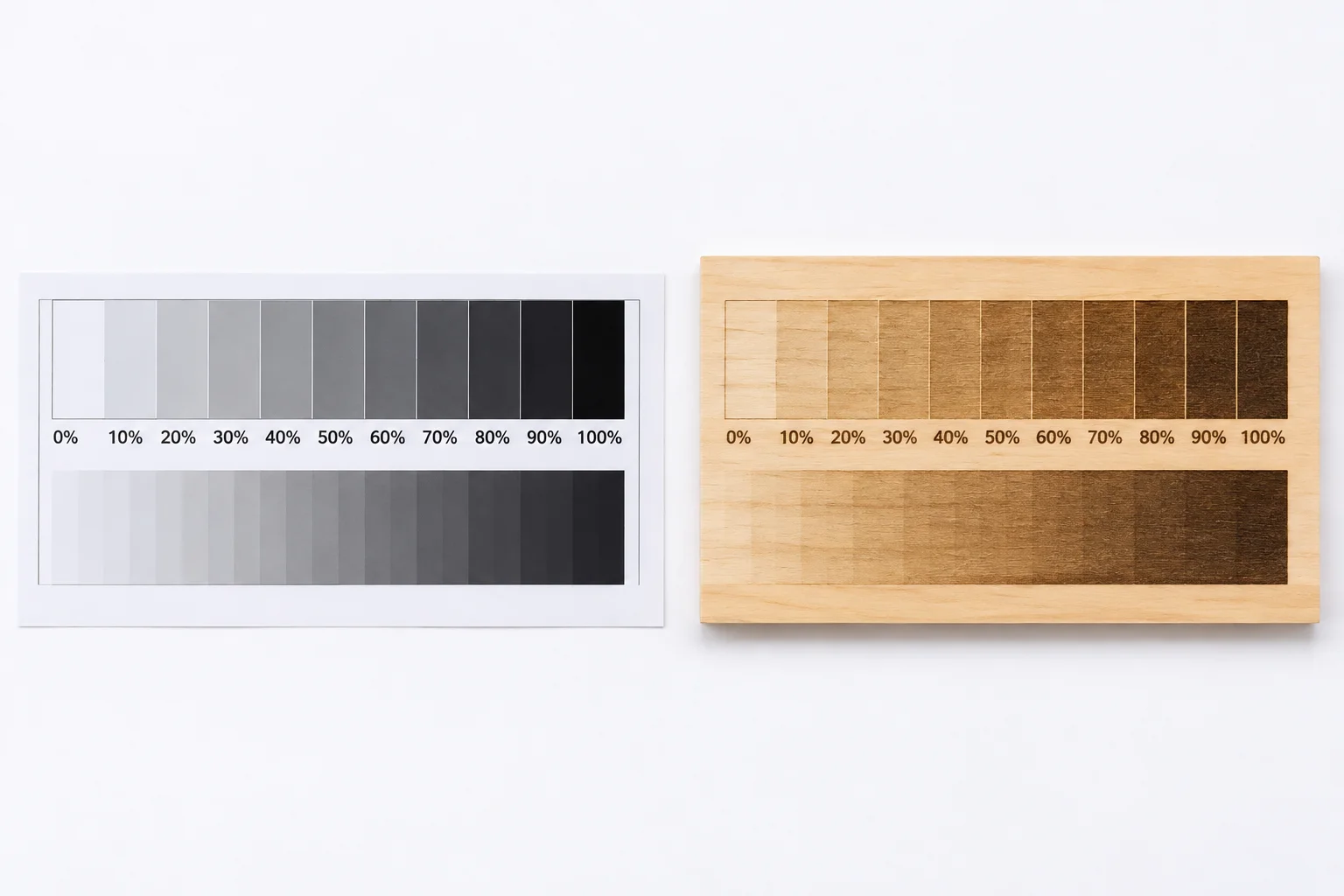
Photographs recorded without physical reference standards cannot serve as verifiable test logs. Lens exposure compensation and sensor color profiles will automatically adjust tonal curves, concealing whether darker patches originate from higher laser duty cycles or automatic digital camera post-processing.
Systematic Surface Readings and Artifacts
During our comparative trial runs across kiln-dried hard maple and coated anodized plates, several confounding variables consistently altered contrast stability. Loose soot layers settle over perimeter zones during high-speed raster movements, artificially lowering the measured L* value by up to twelve units prior to particulate extraction.
Key Metrics in Surface Pyrolysis Evaluation
Standardizing the measurement workflow demands a mandatory five-minute settling period followed by clean pressurized air expulsion at 0.2 MPa. Only post-conditioned marks reflect actual chemical transformation rather than temporary particulate deposit.
- Delta-E spectral divergence between pristine substrate and engraved matrix centers.
- Specular gloss deviation measured at a 60-degree angle to differentiate carbonized matte burns from glassy vitreous layers.
- Micro-edge bleed gradient across orthogonal raster scan boundaries where overlapping passes accumulate thermal saturation.
Long-Term Stability and Ledger Archival
Engraving darkness is rarely static over extended post-treatment windows. Oxidation and ambient moisture absorption alter the refractive index of exposed cellulose bundles within forty-eight hours of thermal processing. In metal annealing trials, thin oxide layers slowly stabilize in ambient atmospheres, shifting color nuances toward deeper bronze tones.
A complete ledger entry demands two distinct temporal timestamps: immediate post-process readings taken within ten minutes, and stabilized equilibrium figures recorded seventy-two hours later in controlled temperature conditions. Incorporating both timestamps into our ledger cards creates genuine predictive accuracy for production runs.