Isolating Independent Variables in Trial Matrices
Laser testing grids routinely circulate throughout workshops and fabrication laboratories as definitive guideposts for speed and power selection. Two operators evaluating identical nominal parameters on seemingly identical materials frequently produce conflicting outcomes. What makes two material tests comparable is not the shared numeric label in an input field, but the rigorous stabilization of all background physical variables. When one operator records a clean surface ablation at 300 mm/s and another experiences heavy localized burning at that exact figure, unseen disparities in optical focus, beam acceleration, or specimen conditioning are skewing the observation.
Establishing valid comparative benchmarks requires treating the laser apparatus and the raw specimen as a paired physical system. Without establishing rigorous controls for focal distance, nozzle gas dynamics, and specimen preparation, grid data remains isolated to the single machine that generated it. A true ledger entry establishes comparability by documenting absolute energy delivery per unit area rather than trusting percentage dials or arbitrary vendor power presets.
Kinematic Velocity Parity and Beam Energy Density
True comparability begins with the delivery of kinetic motion. Software tools define vector velocities in millimeters per second, but physical gantries cannot achieve target speeds instantaneously. When a machine traverses short test patches, acceleration limits dictate that the laser head spends substantial fractions of its movement speeding up and slowing down. If Machine A possesses an acceleration curve of 3,000 mm/s² while Machine B tops out at 1,000 mm/s², the effective dwell time over a 5 mm swatch differs drastically despite matching speed inputs.
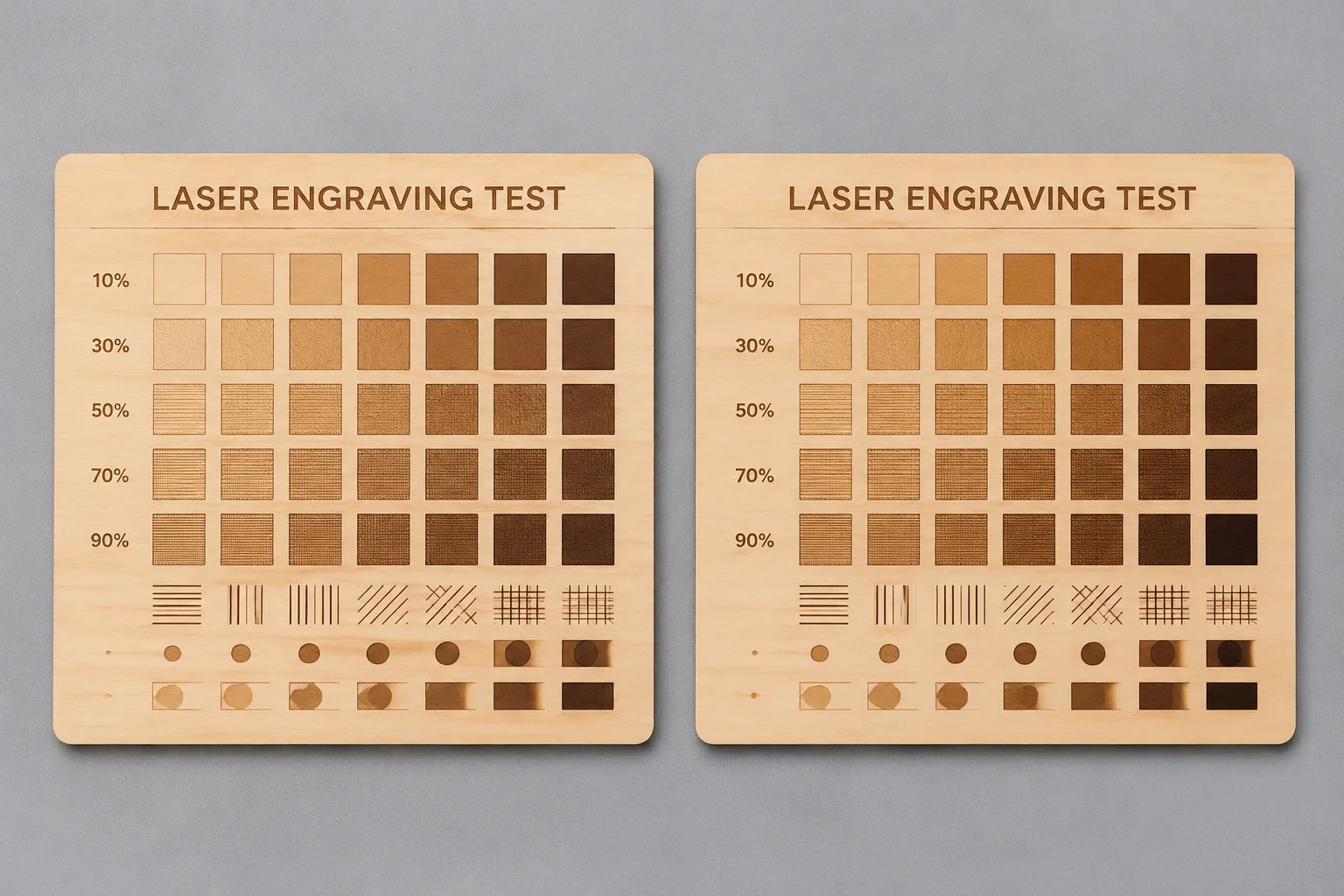
Energy density represents the second major mechanical pillar. A standard plano-convex lens exhibits a defined depth of field where spot diameter reaches its minimum waist. A tiny vertical error of a quarter millimeter doubles the beam cross-sectional area, halving the irradiance delivered to the top surface. Validating comparability between two test records demands verifying that the optical spot size at the workpiece surface was verified using an identical beam diagnostic or focus wedge trial.
Environmental Controls and Substrate Moisture Retention
Even when mechanical equipment states match with laboratory precision, specimens introduce substantial baseline shifts. Organic materials such as birch plywood, solid hardwoods, and vegetable-tanned leather are hygroscopic structures that respond immediately to ambient atmospheric conditions. A test executed on a winter morning in 25% relative humidity will demonstrate crisp char-free edges, while the same board exposed to 75% workshop humidity on a summer afternoon expends significant laser energy simply vaporizing absorbed water before ablation occurs.
Critical Comparison Checkpoints
To determine whether two published ledger sheets can be cross-referenced reliably, evaluators must verify that both runs adhere to fixed operational boundary conditions:
- Specimen core temperature and equilibrium moisture content must be recorded using calibrated contact sensors prior to exposure.
- Assist gas flow rates and nozzle exit distances must be verified to ensure identical cooling and oxidative clearing behavior.
- Line interval spacing in bidirectional raster fills must match spot diameter overlap precisely to avoid false thermal accumulation.
Protocol Synthesis for Ledger Verification
Creating durable records for material libraries requires shifting away from vendor-centric terminology toward reproducible physical units. Fluence, measured in joules per square centimeter, unites beam power, spot dimension, and gantry velocity into an intelligible metric. When trial engineers document tests through standardized fluence levels alongside lens focal lengths and substrate moisture metrics, disparate laboratories can replicate patterns with remarkable consistency.
When reviewing trial records, treat any unverified variable as an immediate source of experimental error. Systematic logging transforms subjective workshop guesses into dependable manufacturing intelligence. By standardizing measurement routines, verifying equipment kinematics, and recording physical workpiece parameters, material databases fulfill their primary mission: delivering repeatable physical predictability.