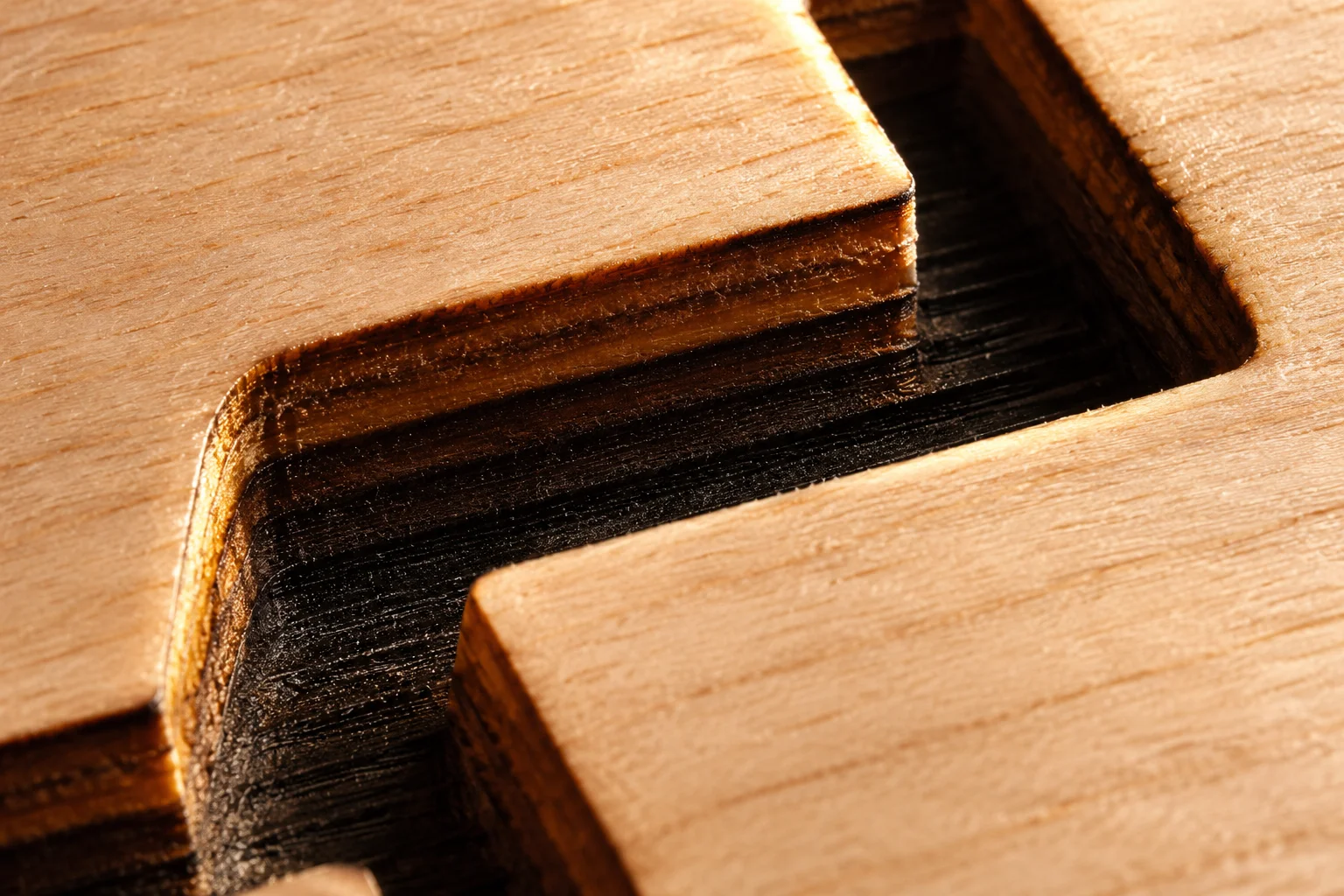
The Flawed Assumption of Linear Ablation
Technicians often treat multiple passes as simple arithmetic multipliers. When a single pass at 200 mm/s and 40% power yields 0.45 mm of clean relief, the natural intuition expects a second identical pass to land near 0.90 mm. In systematic trial logging, this expectation collapses almost immediately. Instead of compounding relief neatly, repeating the path across an already ablated trench triggers a cascading set of physical and optical transitions. The material facing the beam on run two is fundamentally different from the untouched surface encountered during the first run.
The surface has already lost its original moisture, microscopic flat topography, and pristine reflectivity. In solid wood species like kiln-dried maple, the first run burns away cellulose and deposits a dense layer of carbonized char across the bottom of the groove. On cast acrylics, the trench bottom cools into an uneven, semi-refractive recast ridge. Treating both runs under an identical experimental label distorts trial databases and masks the true behavioral mechanics of laser-material interaction.
Optical and Mechanical Boundary Shifts
The primary physical disruption comes from focal plane displacement. Standard focusing lenses create an hourglass-shaped beam waist. When the initial pass cuts a trench, the floor of that trench now sits below the nominal focal point. Unless the z-axis steps downward to recalibrate focus before pass two, the spot size widens significantly at the floor of the cut. This optical divergence drops irradiance density, distributing beam energy over a wider footprint and driving kerf wall erosion instead of pure downward vaporization.
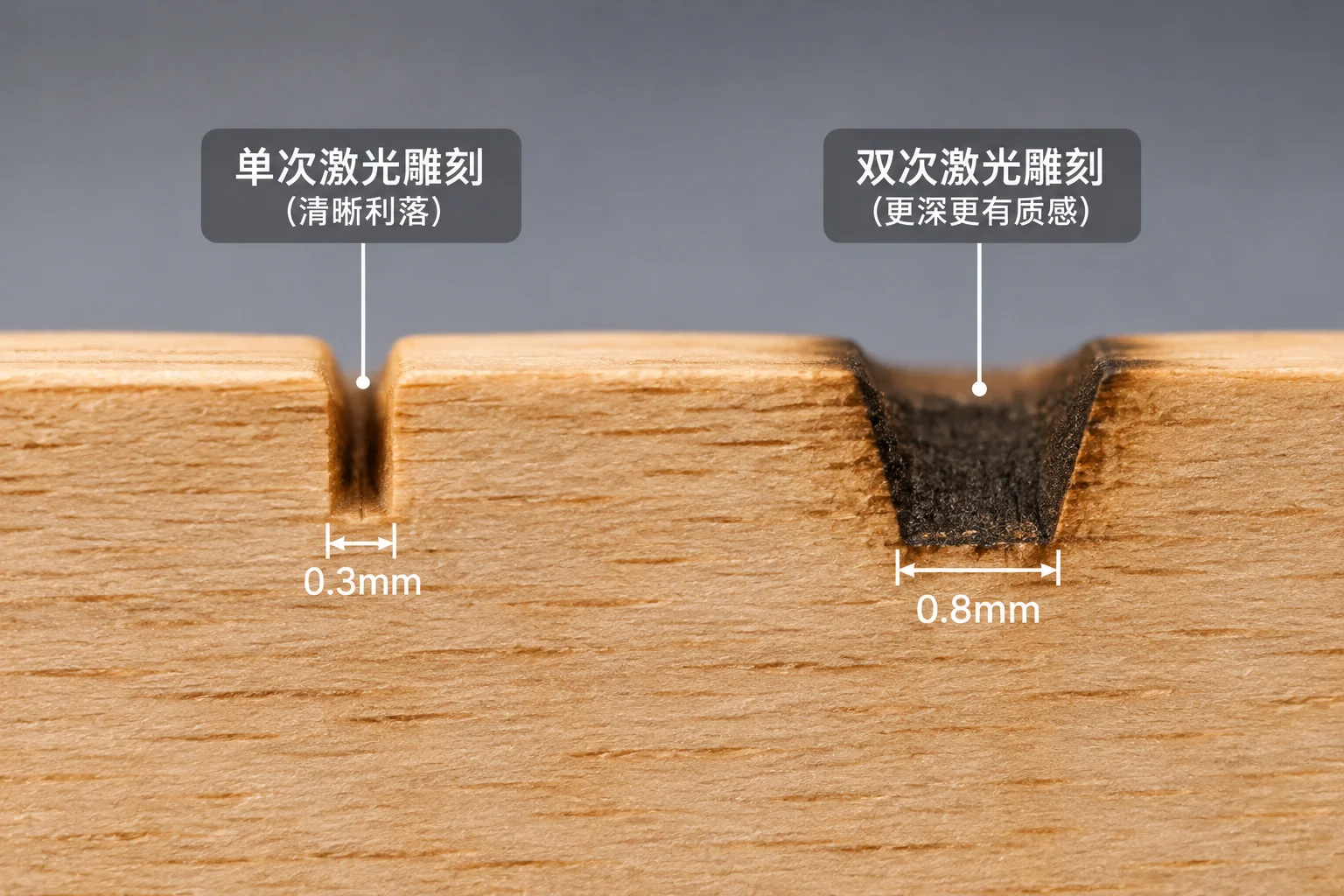
Simultaneously, gas dynamics inside narrow recesses turn turbulent. Standard coaxial air assist nozzles are calibrated to sweep debris across planar sheets. Once an engraving exceeds 0.8 mm in depth, incoming air swirls within the pocket, failing to eject heavier carbon particles. This suspended soot absorbs incoming laser radiation in mid-air before it reaches solid matter, turning useful beam energy into useless air plasma heating.
Systematic Observations in Hardwood Specimens
During our controlled evaluation across sixty maple test coupons, every sample subjected to two unadjusted passes exhibited measurable discrepancies in geometric tolerance. Sidewall taper increased by an average of 14 degrees relative to single-pass baselines, while bottom flat width shrank due to ray divergence along the trench floor. The colorimetric profile also shifted toward deep matte charcoal, obscuring natural grain patterns completely.
Measured Deviations Across Two Sequential Runs
Careful microscopic measurement across our ledger test matrices uncovered three recurring anomalies that invalidate simple depth multiplication assumptions:
- Diminishing Depth Yield: The second pass yielded only 54% to 62% of the depth achieved by the first pass under identical speed and power settings.
- Lateral Thermal Expansion: Residual heat retention caused scorching along the top edge of the cut, widening the entry aperture by up to 0.18 mm.
- Shielding from Char Layers: Compacted carbon crust formed during pass one acted as a thermal insulator, preventing effective vaporization of lower wood fibers until charred debris was manually brushed out.
Documenting Non-Linear Trial Metrics
Standardizing material database records requires recording multi-pass tests as distinct multi-variable trials rather than aggregated multipliers. Whenever testing multi-pass cycles, the ledger entry must specify whether z-step adjustments were applied between cycles, the pause interval allowed for substrate cooling, and whether manual cleaning was performed between sweeps. Without these precise contextual variables, two identical multi-pass test sheets cannot be accurately compared.
Ultimately, a second pass transforms a basic cutting trial into a complex thermal-optical study. By documenting focal drift and surface alteration separately for each cycle, machine operators gain the predictability needed for deep relief engraving without sacrificing edge crispness or structural fidelity.